The site of the Notre-Dame Basilica: 400 years of transformations
For nearly four centuries, the site where the Notre-Dame Basilica stands has watched over the history of Montreal and the soul of a city in constant transformation. The iconic Notre-Dame Basilica itself has also undergone profound changes: construction phases, renovations, sometimes destruction, and always rebirth.
Published on Sep 26th 2025 | Updated on Oct 7th 2025 4 min read.
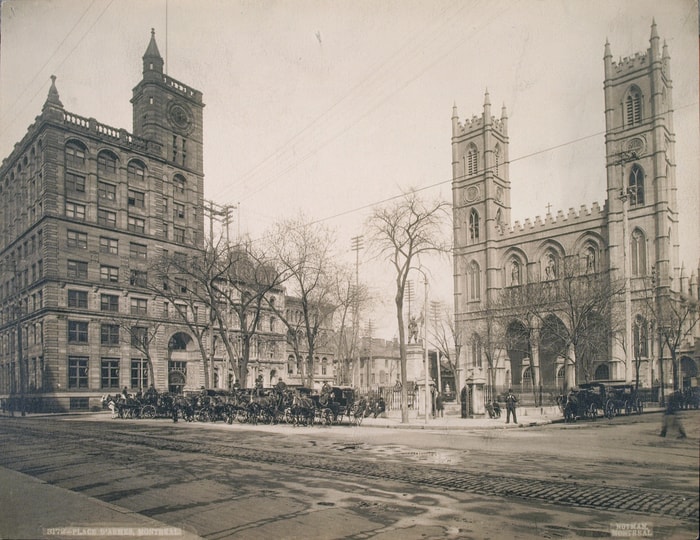
The Basilica's predecessors
In the beginning, there was only a wooden chapel, built in 1642 by the first settlers of Ville-Marie. Modest and functional, it met the spiritual needs of a still fragile community, barely settled on the banks of the St. Lawrence River. In 1672, a first stone-built church appeared on what would become Place de la Fabrique in 1693, renamed Place d'Armes in 1721. Already bearing the Notre-Dame name, this church remained the religious heart of Montreal for over 150 years.
Birth of a monument
At the dawn of the 19th century, Montreal was growing. The existing church had become too small, and it was time to dream of something bigger. Irish architect James O'Donnell was entrusted with imagining a building that would match Montreal's new ambitions. He chose to adopt the neo-Gothic style, which was still rare in North America, and designed an imposing façade inspired by the great European cathedrals. Construction began in 1824, and by 1829, the new Notre-Dame Church of Montreal was opened to worshippers. Monumental in size, it can accommodate up to 8,000 people.
Decades of creativity
Unlike the exterior of the church, the interior came to life much more gradually. For several decades, artisans sculpted, painted, gilded, and decorated every corner of the nave with a meticulousness that still commands admiration today. The Casavant organ, the stained-glass windows recounting the religious history of the city, the deep blue and starry ceiling: each element contributes to making this church a masterpiece. An adjoining chapel, Notre-Dame-du-Sacré-Cœur, was added at the end of the 19th century. More discreet, more contemplative, this chapel offers an intimate counterpoint to the solemnity of the great nave.
Destruction and reconstruction
Unfortunately, a fire completely destroyed the secondary chapel in 1978, leaving only the walls standing. The reconstruction, entrusted to architect Denys Lapointe, gave rise to a very different area: more refined, resolutely contemporary, but still spiritual. Suspended aluminum ceiling, sober lines, controlled lighting... The memory of the space survives in a new form.
Maintaining and preserving
Starting in the 1980s, Notre-Dame Church entered a phase of active preservation. The stone facades were cleaned, the sculptures restored, and the structures reinforced. Time had left its mark, but the quality of the attention paid to the conservation of the building now makes it a model of living heritage. Elevated to the rank of Basilica by Pope John Paul II in 1982, designated a National Historic Site in 1989, the monument has become a permanent construction site: not to rebuild it, but to maintain it, respect it, and pass it on to future generations.
A cultural space
Today, Montreal’s Notre-Dame Basilica is no longer a place of worship only: it is also a space for culture, history, and remembrance. In 2017, the immersive AURA experience was launched, projecting a unique light and sensory display onto the walls of the nave, attracting thousands of visitors each year. Modern lighting technologies have been integrated, paying tribute to the architecture and highlighting its lines. Additionally, the Casavant organ has been restored with great care. Other initiatives were also undertaken: accessibility has been redesigned, archives have been digitized, and expertise has been preserved.
Great attention over time
When we look at the history of the Basilica through the prism of its renovations, the consistency of the commitment is striking. Nothing has ever been left to chance. Every stone laid, every element restored, every architectural decision reflects a deep respect for the site, but also for its history and for those who bring it to life today. The Notre-Dame Basilica of Montreal is by no means frozen in the past: it evolves, adapts, welcomes, and moves people. Above all, it has stood the test of time and continues to watch over the city.